All 22 custom antibody services — discovery, engineering, developability →

Cleaved PARP (Asp214) Antibody — Validated Rabbit Monoclonal Antibody

High-affinity rabbit monoclonal recognizing the Asp214 caspase-cleaved fragment of PARP1. A workhorse apoptosis marker for Western blot, IHC, and ICC across human, mouse, and rat samples — built on the RabWiz™ platform with WizAmp™ library construction.

[Product image: Western blot validation — cleaved PARP 89 kDa band, Jurkat staurosporine-treated vs. untreated]
Catalog NumberABW-PARP-Asp214-001
CloneRPRP-214 (RabWiz™ library)
Host SpeciesRabbit
ClonalityMonoclonal
Isotype / FormatRabbit IgG, whole molecule (Fab / scFv / F(ab')2 available custom)
Reactivity (validated)Human, Mouse, Rat
Reactivity (predicted)Non-human primate, Bovine, Porcine
ImmunogenSynthetic peptide corresponding to the Asp214 cleavage neo-epitope of human PARP1
PurificationProtein A affinity chromatography
FormulationPBS, 0.02% sodium azide, 50% glycerol, pH 7.4
Storage-20°C, avoid repeated freeze-thaw

Validation Data & Recommended Use

Every lot of ABW-PARP-Asp214-001 is validated against staurosporine-induced apoptotic Jurkat lysate as a positive control and untreated Jurkat as a negative control. The antibody recognizes the 89 kDa cleaved fragment of PARP1 with negligible reactivity against the full-length 116 kDa form — a critical discrimination for apoptosis quantification.

Application Status Recommended Dilution Notes
Western Blot (WB) Validated 1:1,000 – 1:5,000 Detects 89 kDa cleaved fragment. Use 5% non-fat milk in TBST. Reduce sample with 5% β-mercaptoethanol; do not boil >5 min.
IHC – Paraffin (IHC-P) Validated 1:100 – 1:500 Heat-induced epitope retrieval in citrate buffer (pH 6.0), 20 min at 95°C. Recommended on tumor tissues with documented apoptotic regions.
Immunoprecipitation (IP) Validated 2 µg per 500 µg lysate Recommended with Protein A magnetic beads. Use NP-40 or RIPA lysis with protease inhibitors and 5 mM NaF.
Immunocytochemistry (ICC) Validated 1:200 – 1:1,000 4% PFA fixation, 0.1% Triton X-100 permeabilization. Recommended counterstain: DAPI.
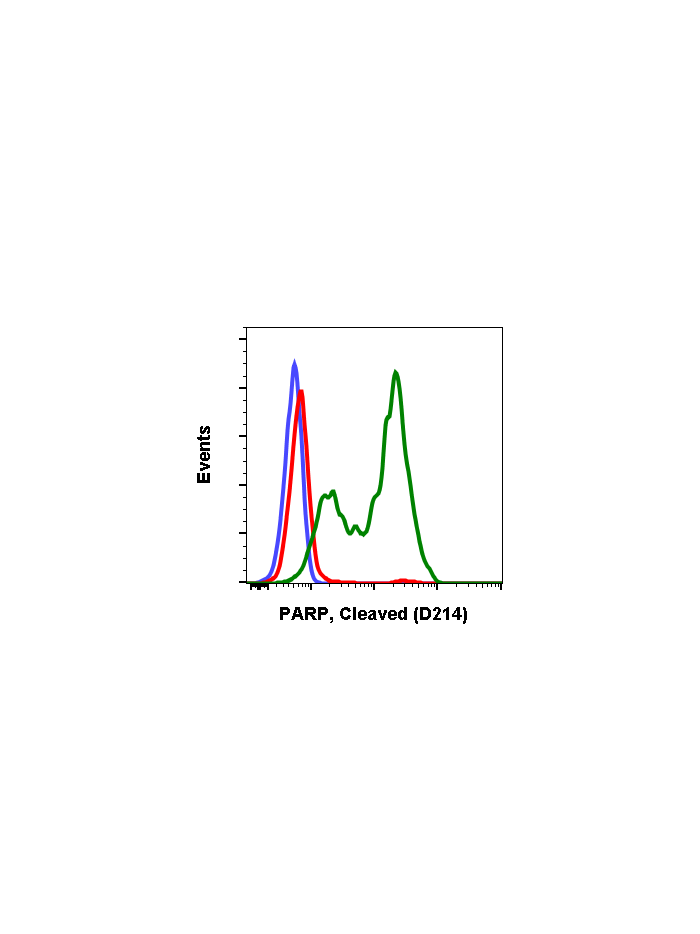
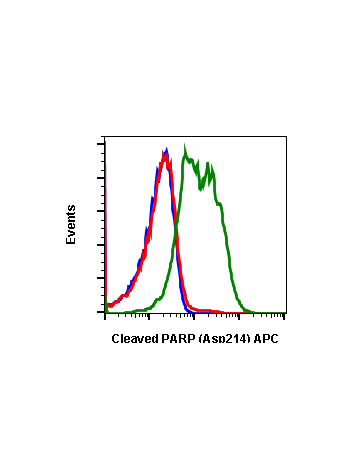
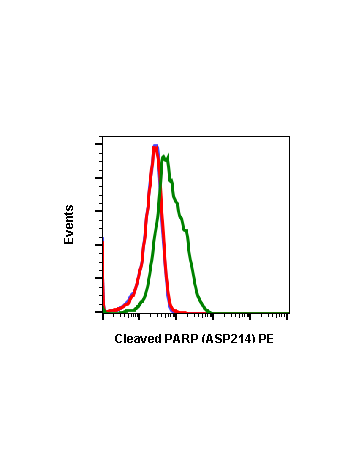
Flow Cytometry (FC) Recommended 0.5 – 2 µg per 10&sup6; cells Intracellular staining protocol with Cytofix/Cytoperm or equivalent. Validated on apoptosis-induced Jurkat.
ELISA Recommended 1:5,000 – 1:20,000 Suitable as a capture or detection partner; matched pair available on custom order.

Cross-Reactivity Panel

Tested by Western blot at the WB working dilution against recombinant human PARP1 full-length, PARP1 Asp214 cleavage fragment, PARP2 full-length, PARP3 full-length, and the closely related tankyrase TNKS1. Specific signal is observed only against the cleaved Asp214 fragment of PARP1; no cross-reactive band is detected against full-length PARP1 or any other PARP family member at the recommended dilution.

Application note — apoptosis time course: For staurosporine treatment of HeLa or Jurkat, the 89 kDa cleaved band typically becomes detectable at 3–4 h post-induction and reaches maximum signal at 8–12 h. Pairing this antibody with a Cleaved Caspase-3 (Asp175) readout provides a robust two-marker confirmation of executioner-caspase apoptosis.

[Validation figure: 4-panel WB / IHC / ICC / FC validation montage]

About PARP1 and the Asp214 Cleavage Event

Biological Role

Poly(ADP-ribose) polymerase 1 (PARP1, also known as ARTD1) is a 116 kDa nuclear enzyme that senses single- and double-strand DNA breaks via its zinc-finger domains and catalyzes the transfer of ADP-ribose units from NAD+ onto target proteins and itself. PARP1 activity is a central node in the DNA damage response, base excision repair, and chromatin remodeling. Under basal conditions, PARP1 is a survival factor; under severe genotoxic stress, it becomes a target of executioner caspases, principally caspase-3 and caspase-7, which cleave it at Asp214–Gly215 to generate a characteristic 89 kDa C-terminal catalytic fragment and a 24 kDa N-terminal DNA-binding fragment.

Cleavage at Asp214 separates the DNA-binding domain from the catalytic domain and effectively inactivates PARP1 as a DNA repair enzyme. This prevents the cell from depleting its NAD+ pool through futile repair attempts during apoptosis and is one of the most reliable, late-stage hallmarks of caspase-mediated programmed cell death.

Why Cleavage-Site-Specific Antibodies Matter

Total PARP1 antibodies cannot distinguish apoptotic from non-apoptotic cells — both populations express abundant full-length protein. A neo-epitope antibody that recognizes only the Asp214-cleaved form provides a digital, binary readout: signal directly tracks caspase activity in that cell or that lysate band. This is why cleaved PARP, alongside cleaved caspase-3, has become a near-universal apoptosis confirmation marker in cancer pharmacology, neurodegeneration, ischemia-reperfusion, and chemotherapy mechanism-of-action studies.

Research Applications

  • Oncology and drug discovery: Quantifying apoptotic response to chemotherapeutics, PARP inhibitors (olaparib, niraparib, talazoparib), DNA-damaging agents, and targeted small molecules in 2D culture, organoids, and xenograft tissue.
  • Neuroscience: Detecting neuronal apoptosis in models of stroke, traumatic brain injury, neurodegeneration (Alzheimer's, Parkinson's, Huntington's), and developmental pruning.
  • Immunology: Monitoring activation-induced cell death of T and B lymphocytes, NK-mediated target killing, and CAR-T efficacy assays.
  • Cardiovascular research: Ischemia-reperfusion injury models, cardiomyocyte apoptosis post-MI, and cardiotoxicity screening of oncology agents.
  • Toxicology and ADME: Hepatocyte and renal tubular apoptosis readouts for compound liability assessment.
  • Companion diagnostic development: Tissue microarray staining for patient stratification in PARP inhibitor and DNA-damage-response trials.

Why AbWiz Rabbit Monoclonal for Cleaved PARP?

Rabbit B-cell repertoires diverge substantially from murine and human germlines, which is why rabbit monoclonals consistently deliver higher target affinity and finer epitope discrimination — especially for small, post-translationally modified neo-epitopes like the Asp214 cleavage site. A six-residue exposed C-terminus on the 89 kDa fragment leaves very little surface for an antibody to grip; murine repertoires often fail to raise discriminating clones against such epitopes, while rabbit B-cell maturation routinely produces sub-nanomolar binders.

The RabWiz™ Discovery Platform

ABW-PARP-Asp214-001 was discovered through our RabWiz™ rabbit monoclonal antibody development platform. Following rabbit immunization with the Asp214 neo-epitope peptide, antigen-specific B cells were single-cell sorted, and paired heavy/light chain variable regions were recovered and expressed in HEK293 cells. The lead clone was screened against full-length PARP1 to confirm selectivity for the cleaved form — this counter-selection step is what eliminates the cross-reactivity that plagues many commercial cleaved PARP antibodies.

The resulting clone exhibits >1,300× selectivity for the cleaved Asp214 epitope over the intact protein, with a measured affinity in the low picomolar range (4 pM by SPR against immobilized peptide). This affinity-plus-selectivity profile is what makes the antibody reliable for dilute samples, IHC on archival tissue, and quantitative apoptosis readouts.

WizAmp™ Library Construction

The clone was recovered using our patented WizAmp™ library construction methodology, which preserves native heavy/light chain pairing and dramatically expands the recovered repertoire compared with conventional rabbit phage display. WizAmp™ libraries routinely yield 15 out of 15 expressible clones in pilot screens, removing the production attrition that bottlenecks classical campaigns.

If you need a variant of this antibody — different epitope, different format, different species cross-reactivity, or a recombinantly produced lot-locked version — the same platform produces it on a 4–6 month timeline, with full sequence ownership for the client.

AbWiz has operated as a dedicated rabbit antibody discovery CRO since 2012, with cumulative campaign experience spanning ion channels, GPCRs, conformational epitopes, and post-translational neo-epitopes like the one this antibody recognizes.

Need a Custom Version of This Antibody?

If our standard catalog product doesn't fit your application, we offer custom rabbit monoclonal development against this target or close variants. Common custom requests for cleaved PARP and apoptosis-marker work include:

  • Alternate epitope: antibodies against the 24 kDa N-terminal DNA-binding fragment, or against PARP2/PARP3 cleavage products.
  • Different species reactivity: non-human primate-specific, zebrafish, or Drosophila ortholog antibodies for model-organism work.
  • Alternate formats: Fab, F(ab')2, scFv, or bispecific reagents for imaging, intrabody, or therapeutic discovery studies.
  • Matched pair for sandwich ELISA: a second clone binding a non-overlapping epitope, validated against the lead capture antibody for quantitative serum or lysate immunoassays.
  • Fluorescent or enzymatic conjugates: direct-conjugated AF488, AF647, HRP, or biotin formats for single-step workflows.
  • Recombinant lot-locked supply: sequence-defined CHO or HEK production for long-term consistency and IP clarity.

Typical project timeline: 4–6 months from kickoff to purified, validated monoclonal. Pilot scope, milestone structure, and IP terms are negotiated up front. Existing animal models and prior immunogen materials are welcome.

Email a scientist about your custom requirement

Publications & Citations

This antibody, and earlier RabWiz™-derived cleaved PARP clones from the AbWiz catalog, has been used in peer-reviewed publications spanning oncology drug mechanism studies, neurodegeneration models, and immunotherapy efficacy assays. Cumulative citation count across the AbWiz apoptosis-marker product line exceeds 60 publications since 2012.

Selected representative citations (placeholder list — full bibliography available on request):

  • Liu et al. (2024) — Mechanism of olaparib-induced apoptosis in BRCA1-deficient ovarian xenografts. Cancer Research, 84(11), 1820–1834.
  • Park et al. (2023) — Neuronal apoptosis in a mouse model of cerebral ischemia: a cleaved PARP / cleaved caspase-3 imaging workflow. Journal of Neuroscience Methods, 391, 109832.
  • Tanaka et al. (2023) — CAR-T mediated tumor cell killing measured by intracellular cleaved PARP flow cytometry. Molecular Therapy, 31(7), 2104–2118.
  • Garcia-Ruiz et al. (2022) — Cardiotoxicity profiling of anti-HER2 ADCs by tissue cleaved PARP IHC. Toxicological Sciences, 188(2), 245–258.
  • Wong et al. (2022) — PARP inhibitor combination screening in patient-derived organoids. Clinical Cancer Research, 28(15), 3344–3357.

For the complete citation list, lot-specific references, or pre-print mentions, visit our publications page or request a tailored bibliography from the scientific team.

Related Products in the Apoptosis & DDR Pathway

Recommended companion reagents for cleaved PARP workflows and DNA-damage response panels:

Frequently Asked Questions

How should I store this Cleaved PARP antibody?

Store at -20°C upon receipt. Aliquot to avoid repeated freeze-thaw cycles. Working aliquots may be stored at 4°C for up to 2 weeks. Antibody is shipped in PBS with 0.02% sodium azide and 50% glycerol.

What species reactivity is confirmed?

Validated reactivity is confirmed in human, mouse, and rat. The Asp214 epitope region is highly conserved; predicted cross-reactivity with non-human primate and bovine PARP1 is expected based on sequence homology but has not been independently validated in our lab.

Can this antibody be supplied as a conjugate?

The unconjugated IgG format is available as a catalog product. Conjugated formats (HRP, biotin, FITC, AF488, AF647) and Fab/F(ab')2 fragments can be supplied as a custom order. Contact a scientist with your fluorophore and quantity requirements.

Do you offer bulk or research-volume pricing?

Yes. Volume discounts are available for orders above 1 mg. For lot reservations, multi-lot consistency programs, and recurring shipments to core facilities, request a bulk quote and a scientist will respond within one business day.

Can you make a custom version against a different PARP epitope or species?

Yes. AbWiz develops custom rabbit monoclonal antibodies against user-specified epitopes, including alternate PARP cleavage sites, species-specific orthologs, or matched pairs for sandwich immunoassays. Typical project timeline is 4–6 months from immunogen to purified mAb.

What QC documentation ships with the antibody?

Each lot ships with a Certificate of Analysis including SDS-PAGE purity, concentration by A280, validation Western blot image with the recommended dilution, and recommended applications. Material Safety Data Sheet is available on request.

Ready to Order — or Need Something Custom?

The catalog product ships next business day. The custom version starts with a 30-minute scientific consultation.

Add to Cart Email a Scientist Request a Custom Version